In a recent post published on LinkedIn Grindr CEO George Arison boasted that “Grindr actively chooses not to give information about our users to third-party partners—even if that means fewer ad dollars”.
It seems a bit rich, considering Grindr’s pretty chequered past when it comes to privacy. I guess the sudden focus on privacy stems from Grindr’s stock market float, putting them under more scrutiny to operate in a different way than they used to now they are a publicly traded company and responsible to the markets and their shareholders.
Arison conveniently neglected to mention that Grindr was given a massive $6m fine by the Norwegian Data Inspectorate a few years ago – for failing to protect the privacy of their users. In 2022 the UK Information Commissioner’s office issued Grindr with a reprimand, believing Grindr had infringed GDPR Regulations at the time. The UK Solicitors firm Austen Hays currently have a pending group claim stating that “Grindr appears to have shared user’s personal data for profit with numerous advertisers for online behavioural marketing purposes”. Most worryingly, they may have shared sensitive information such as your HIV status.
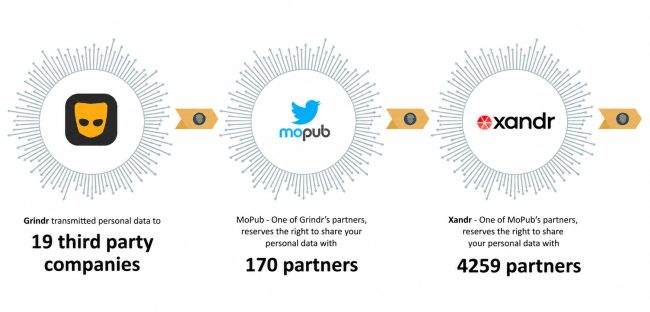
Then in October 2026 the The Norwegian Data Protection Authority issued an administrative fine of 92 million Norwegian kroner, equivalent to €8.6 million, to a company called Xandr – now owned by Microsoft. Note that although the fine has been imposed the parties fined can still appeal the decision so it may take several more years until we have a final conclusion to this saga.
Source: Copyleft/Norwegian Consumer Council
The fine is substantial but merely highlights an issue that is not unique to Grindr in any way: when you sign up to any hookup or dating app it is very hard to figure out how data about yourself could be passed on to third parties. To be fair to Grindr, they are now making this much easier – but you still have to provide consent or withdraw consent. The question is how many users actually bother with withdrawing their consent – if you are horny and want to hookup with another guy that is probably the furthest on your mind!
The Data Protection Authority [Datatilsynet] stated that “Xandr acted as an intermediary that relayed the personal data of Grindr users in Norway, including data revealing sexual orientation, to potentially thousands of other companies. Xandr defended itself by saying that they thought Grindr had collected users’ consent, but the Norwegian Data Protection Authority does not accept that actors can simply blame one another.” I agree that simply assuming the data you have received has been the subject of completely informed consent is not enough. I also doubt most users even understand what they consent to when they do consent, amidst all the legalese text and complex definitions not just Grindr but many other hookup/dating apps present us with.
There are a lot of implications here, not least because being flagged as “gay” within your data, merely by signing up for a hookup app where there are many gay users, could put you at risk. Add to this that many users of these apps are NOT gay, but they do want to hook up with other men and the situation becomes even more complicated. Let’s take an example: You sign up for one of these apps. Through the combination of data a profile is formed of you. The advertising algorithm starts showing you ads for other gay hookup apps – on a computer you share with your wife. Or at work.
The Norwegian Consumer’s Council [Forbrukerrådet] also raise another important point: What happens when your personal data is combined from different sources? With many data points from different sources it is now easier than ever to form a pretty complete picture of you as a person. With the increased use of AI this will only become more precise.
The API scandal
Going back even further, someone reverse engineered Grindr’s API – and figured out that by making a few smart calls to their REST API they could obtain information about users as well as pretty accurately pinpoint their location. It was also discovered that HIV status, if collected from the user, was transmitted along with other user data to several third parties. Ouch. Since then the holes have been plugged, Grindr have stated they will treat HIV data separately and will not be shared or allow you to filter on it.
The Proximity Conundrum
All grid-based dating/hookup apps like Grindr, Hornet and Growler have the same selling point: They show you proximity to other users in a grid, allowing you to browse and contact users that are near to you – obviously with the view to instantly meet each other. It’s the mix of proximity and instantaneousness that is the formula for success for these types of apps. But it also comes with a price: It’s fairly easy to pinpoint someone’s location, and fairly easy to track your movements through these apps. Just now in 2024 card-based apps Bumble and Hinge were found to have flaws where you could pinpoint the location of users down to 2 metres:
During the recent Paris Olympics Grindr created a virtual “fence” around the Olympic Village:
It really neatly illustrates the conundrum: if you can’t see how far away other users are the app suddenly has much less value. Who wants to go ask each one how far they are away, just for a hookup? The whole point of the app is to see who is near you in the grid. That’s how they make their money.
You can to a certain point protect yourself like this: Turn off Show Me in Explore Searches ✅
Turn off Show My Distance ✅
Show me in Explore returns your profile to someone who is outside of your area, searching for users in a different city or country. Turn off Show My Distance and the exact distance from your user to their profile is not shown when you tap their profile from the grid.
…but that only helps to a certain degree. Let me explain.
Let’s take a random user in Johannesburg, South Africa.
In Grindr I select a location in Joburg, for example Sandton.
I tap on Hairy Dad from the grid. I add him as a Favourite so I can easily go back and find him.
“Hairy Dad” appears in a certain place in the grid. I make a mental note of this. To then narrow down his location I move the map location up towards Woodmead. I go back to the grid and check where Hairy Dad is now, relative to the users who were next to him before. If he is further up the grid it means he is nearer to where I selected. I then go back and choose another map location, and then see where he is in the grid. By choosing 3 different locations you can triangulate and from there, you can narrow it down even further. For example, I may find he is somewhere in Marlboro Gardens. I can’t tell exactly where but now I know the (small) area where he is.
I can even move my map around just slightly to pinpoint the street he’s in, by using the technique above.
Although tedious – this is possible!
So I start chatting to Hairy Dad. He says he’s at home. Sends me a few photos. One of them is taken from his living room, looking out on his balcony. Cross-referencing with Google Street View I know know which block he lives in. Finding someone’s location from a few clues is easier than you might think, just check out Jose Monkey on TikTok. The user then tells me he works as a lawyer. On the Monday I repeat the same exercise as above. Tue and Wed I do the same and find he always moves his location to the same place every weekday. So now I know the area where he works. All I have to do now is find what law firms are in that area, and if several move my map location just slightly to pinpoint it.
So now I have his photo, his home location and his work location. I can probably even follow him on weekends, maybe he goes to a gay club and fires up Grindr from there? Ah wait, he does. On several weekends his location is near The Factory, a gay nude bar in a nondescript industrial area in Doornfontein.
Interestingly, the Grindr Terms and Conditions now explicitly warn against this scenario, stating that sophisticated users could determine your location in certain cases.
If you think this is creepy, it’s because it kind of is. I just wanted to illustrate the downside of grid-based apps and how easy it might be to follow someone through the app and gain an insight into their lives.
What is shared, to whom?
All the apps send data about your user to third parties. These are marketing platforms that take data about users to in turn build up demographical profiles to enable advertisers to reach their desired demographics.
Grindr is a good example of to how many places metadata about your user is being shared.
Notice when you now log in you have an option to accept all cookies, reject all or select? Tap Show Purposes:
Confused yet? This is called Consent Management. Grindr have gone to the biggest global player in the field for this, One Trust, and through their platform you can now consent to metadata about your profile to be shared with third parties. Exactly what is shared is detailed here. It’s not much. But the amount of choices are bewildering and the list of vendors is quite long. You can go to Settings –> Consent Preference Center at any time and toggle what your app provides. I doubt many people ever do this – but you can!




 Interestingly, the Grindr Terms and Conditions now explicitly warn against this scenario, stating that sophisticated users could determine your location in certain cases.


Leave a Reply